How to Get Around Jeju Island Without a Car

If you are wondering how to get around Jeju Island without a car, the answer is yes, you can, and the bus network reaches almost everything a first-time visitor wants to see. I say this as someone who drives here regularly for work and still takes the bus on my own days off, because the honest cost of going car-free is time, not access. What follows is the real fare table, the routes that matter, the licence rules that catch renters out, and the point at which I tell people to simply book a guided day instead of fighting the schedule.
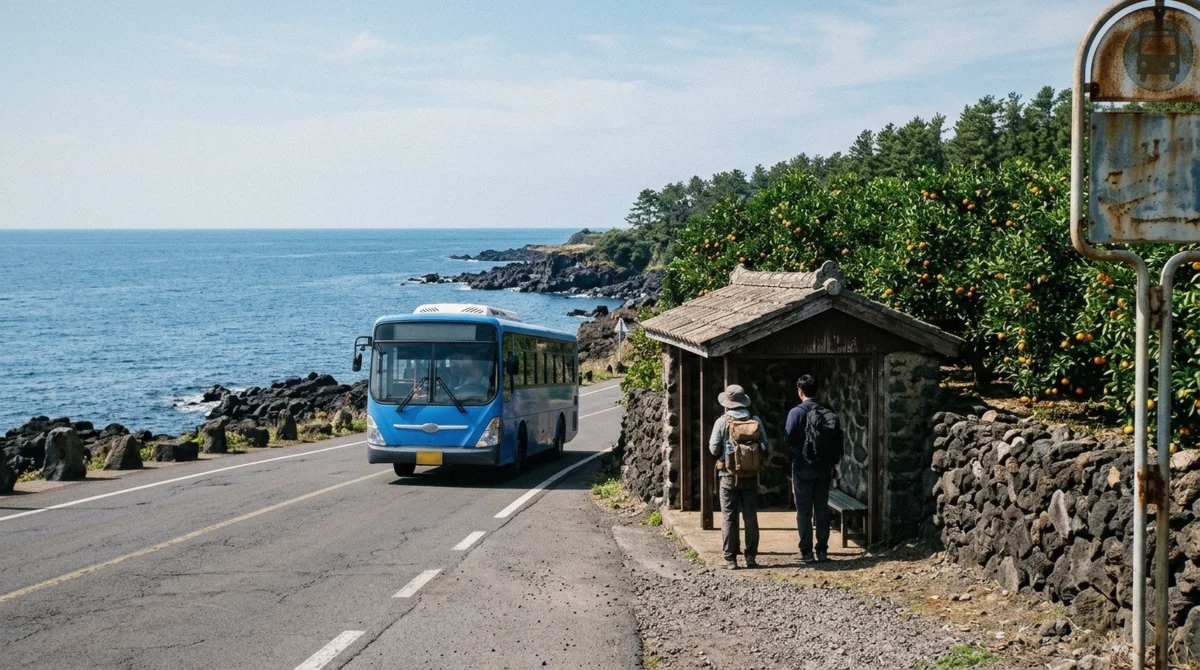
Quick answer
Yes, you can get around Jeju without a car. The island bus network, run through Jeju Bus Terminal, reaches every major coastal sight, and a flat fare and free transfers keep it cheap. The real cost is time: a bus day takes noticeably longer than a car day, which is where a guided day tour of Jeju earns its price for a tight schedule.
Key takeaways
- Bus fare is a flat ₩1,150 with a T-money card, ₩1,200 cash, about $0.80, island-wide
- T-money gives you two free transfers, each within 40 minutes of tapping off, which makes multi-leg days affordable
- Renting a car is legal here for most foreign licences, but the international driving permit rules trip up more travelers than the roads do, see the section below before you book a rental
- Google Maps has no transit directions in South Korea; use Naver Map or KakaoMap for real bus times
- A worked day to Seongsan and back by bus is realistic, see the example below, but it eats most of a day that a three-day car-free itinerary needs to budget for honestly
- For a first visit trying to cover both coasts in a short trip, guided days like the east Jeju UNESCO day tour simply move faster than the bus network can, and the full cost breakdown shows exactly what each option runs
The Guided Alternative, for the Days the Bus Can't Cover Well
These are the options I point people to once the bus math stops working for their schedule, plus the one built specifically for travelers based in Seogwipo.
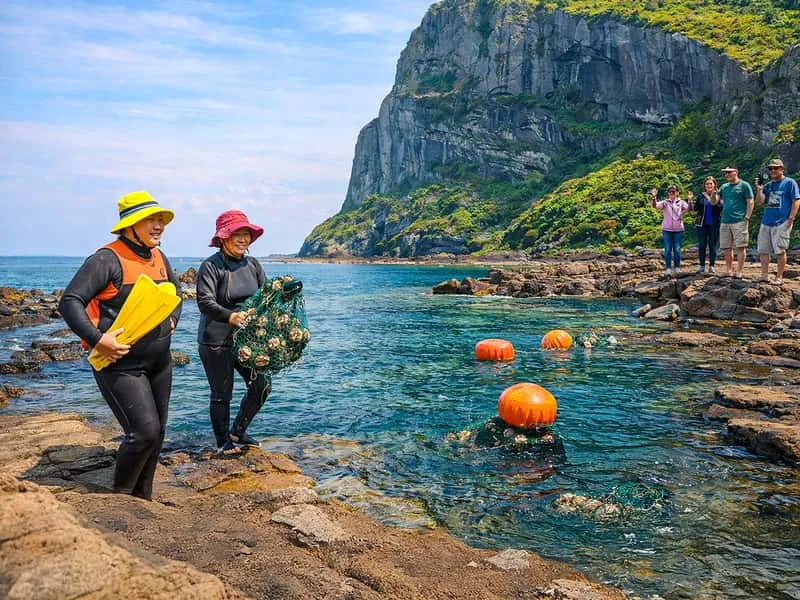 from $30Bestseller · 4.9★ (1,916 reviews)
 East Jeju UNESCO Day Tour: Seongsan, Haenyeo Show & Lava Tube
Explore the UNESCO wonders of eastern and northern Jeju in a single day — sunrise-peak views at Seongsan Ilchulbong, a walk inside a volcanic lava tube, and a…
- Climb Seongsan Ilchulbong (Sunrise Peak), a UNESCO tuff cone rising from the sea
- Step inside an ancient volcanic lava tube on the island's east coast
- Watch a live Haenyeo show by Jeju's UNESCO-listed women free-divers
- Full day of eastern and northern Jeju history, culture and coastal nature
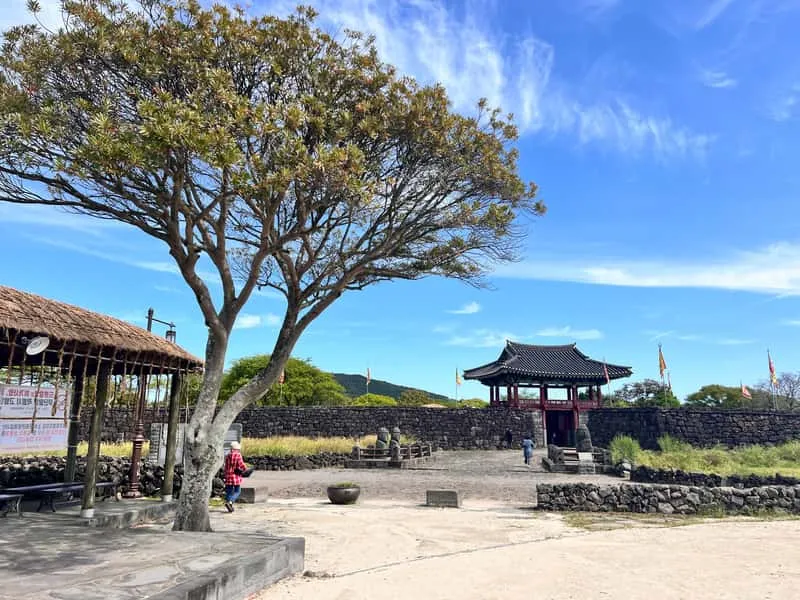 from $90Perfect 5.0★ · departs Seogwipo
 East Jeju Bus Tour Departing from Seogwipo City
A convenient east-Jeju day tour that departs from Seogwipo City near Olle Market and Cheonjiyeon Falls, so travellers staying in the south don't have to backtrack to Jeju…
- Convenient departure from Seogwipo City in southern Jeju
- No backtracking to Jeju City or the airport to start
- Full day exploring eastern Jeju's coast and UNESCO sights
- Near Olle Market and Cheonjiyeon Falls
 from $282Private · fully customisable
 Jeju Private Car Charter Tour with Driver-Guide
Design your own day on Jeju with a private car and personal driver-guide. Choose the attractions that interest you most and travel at your own pace, covering the…
- Private car and personal driver-guide for your group only
- Build your own itinerary around the sights you care about
- Travel at your own relaxed pace across the island
- Covers Jeju's most popular attractions on a flexible route
Your Four Ways Around Jeju
Every visitor ends up choosing some mix of these four. None of them is wrong, but each one costs you something different.
| Option | What it costs | What it is good for | What it costs you |
|---|---|---|---|
| The bus | ₩1,150 with T-money, flat fare, about $0.80 (Last verified: August 2026) | Reaching every major coastal sight cheaply, with free transfers within 40 minutes | Time; routes run every 15 to 30 minutes, not on demand, and cross-island trips still take real time |
| Taxis | Base fare about ₩3,300 for a standard cab, ₩4,500 for a jumbo (about $2.30 to $3.20) | Short hops, late-night returns, or the last mile from a bus stop to your actual door | Cost adds up fast over a full day of point-to-point rides |
| Renting a car | Typical daily rate for a compact is often quoted well under $50 by booking aggregators, treat that as a market estimate rather than a fixed figure | Full flexibility, reaching trailheads and quiet coastline the bus doesn't serve well | The international driving permit rules below, which genuinely disqualify some travelers |
| A guided day | Guided full days on this site start at $30 per person and pick up in Jeju City; the Seogwipo departure starts at $90 | Covering the most ground in the least time with the transport, sequencing and closures already handled for you | Less flexibility to linger or change plans mid-day than driving yourself |
The Bus Network, Honestly
The fare is a flat ₩1,150 with a T-money card, ₩1,200 if you pay cash, about $0.80 either way at the ₩1,415 rate current in August 2026. T-money is the same countrywide transit card used in Seoul and every other Korean city; buy and top it up at any convenience store, and it gives you two free transfers, each within 40 minutes of tapping off, which makes stringing together a multi-stop day genuinely affordable rather than something you pay for leg by leg.
Four routes matter most for a visitor. Route 201 runs around the east coast between Jeju Bus Terminal, Seongsan Ilchulbong and Seogwipo Bus Terminal, roughly every 15 to 30 minutes. Route 202 does the same loop around the west coast, roughly every 15 to 25 minutes.
Routes 181 and 182 are the cross-island express, running from the airport and Jeju Bus Terminal to Seogwipo over the middle of the island rather than around it, which makes them the fast way between the two cities rather than the scenic one. Bus 600 is the airport limousine if you're heading straight out from Jeju International Airport.
The one honest warning I give every visitor: Google Maps does not give transit directions in South Korea. It will show you the roads but not a single bus time. Naver Map or KakaoMap are what locals and long-time expats actually use for live bus arrivals and route planning, and installing one before you land saves a lot of standing at a bus stop guessing.
The official schedule and route portal is bus.jeju.go.kr, which has an English toggle if you want to cross-check a route in advance.
Why Renting a Car Is Harder Than It Looks
This is the section I wish more rental sites explained clearly, because the common claim online that Korea only accepts one type of international driving permit is simply wrong, and the real rule catches the opposite group of travelers off guard.
South Korea recognises both the 1949 Geneva Convention international driving permit and, since January 2002, the 1968 Vienna Convention permit (easylaw.go.kr, the government's own legal information portal). Either version works at a Jeju rental desk. The permit itself is valid for one year from the date you enter Korea, and you need to bring your physical home licence and your passport alongside it; the IDP alone is not accepted on its own.
The trap runs the other direction. An IDP is only valid if the country that issued it is a party to one of those two conventions in the first place. China has ratified neither the 1949 nor the 1968 convention, so a Chinese-issued driving licence cannot be turned into an IDP that Korea will accept, no matter how the permit itself is printed.
Russia is also commonly named in the same category. Beyond those, I'd tell any traveler to check with their own licensing authority which convention their IDP falls under before assuming a rental desk in Jeju will simply take it.
The penalty for driving without a valid licence or a valid permit is real: up to one year's imprisonment or a fine of up to ₩3,000,000, about $2,120, under Korean law (easylaw.go.kr). That is not a rental-company inconvenience, it is the legal consequence, which is why I take the question seriously every time someone asks me whether their licence will work here. Rental desks themselves also commonly set their own minimum-age and minimum-licence-holding-period policies on top of the legal requirement; those are company rules, not law, so they vary desk to desk and are worth confirming directly with whichever counter you're booking, not assumed as a fixed nationwide standard.
Taxis, Kakao T and the Provincial English-Speaking Taxi Service
A standard taxi's base fare runs about ₩3,300 for the first two kilometres, about $2.30, with jumbo or deluxe cabs starting closer to ₩4,500, about $3.20 (Last verified: August 2026). Kakao T is the ride-hailing app everyone here actually uses, the same way Uber works in other countries, and it's worth installing before you land. Uber itself does not operate in South Korea, so don't count on it as a fallback.
Jeju Global Taxi is the provincial service built specifically for visitors, with English- and Chinese-speaking drivers who can run a full sightseeing day rather than just a point-to-point ride. I've had guests use it as a private-guide alternative on days when they wanted flexibility without renting a car themselves; the exact hourly and daily rates vary by booking, so I won't quote a fixed figure here, but it's worth calling ahead if a single point-to-point taxi day starts looking expensive compared to hiring one driver for the whole day.
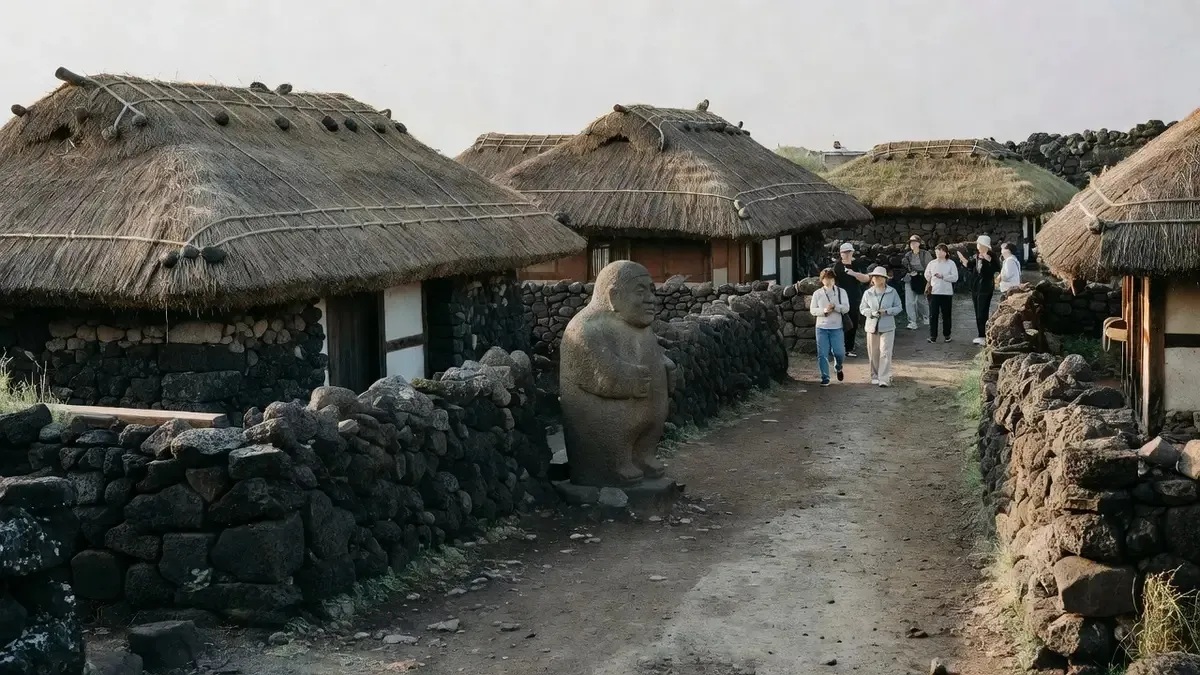
Which Way Fits Your Trip?
If you have five or more days and don't mind a published schedule
the bus network genuinely covers Jeju well, and route 201 or 202 alone handles most of a coastal day
If you're traveling as a family or a group of four or more
a own driver-guide for the day from $282 for the vehicle often beats what everyone would pay separately on shared transport plus a shared tour
If your own country's licence issues an IDP under the 1949 or 1968 convention and you want full flexibility
renting a car is a real option, once you've read the licence rules below
If you have two or three days and want both coasts covered without timetable stress
book a guided day and put the time you'd spend planning routes toward actually being on the island
A Day Without a Car: Worked Example to Seongsan and Back
Here's what a real bus day to the east coast looks like, starting from Jeju City. Catch route 201 from Jeju Bus Terminal toward Seongsan Ilchulbong; the route runs every 15 to 30 minutes, so build in a buffer rather than timing it to the minute. From the Seongsan stop it's a short walk to the ticket gate, where admission is ₩5,000, about $3.50.
After the climb, the same route 201 continues on toward Seogwipo, or you can flag it back the way you came toward Jeju City. Add a stop at Seongeup Folk Village along the way if your timing allows, since it sits near the same corridor and costs nothing to walk through. If your onward plan includes Hallasan rather than the coast, the mountain's own trailhead access and reservation rules are covered separately on climbing Hallasan, since a summit attempt needs its own dedicated day regardless of how you get around.
| Leg | Route | Approx cost |
|---|---|---|
| Jeju City to Seongsan Ilchulbong | Bus 201, east coast | ₩1,150 (about $0.80) |
| Seongsan Ilchulbong admission | Ticket gate at the base | ₩5,000 (about $3.50) |
| Seongsan to Seongeup Folk Village | Free transfer within 40 minutes on a connecting local route | Included in the same T-money tap, or a fresh ₩1,150 fare if outside the transfer window |
| Return to Jeju City | Bus 201 back toward Jeju Bus Terminal | ₩1,150 (about $0.80) |
The honest trade-off: this whole loop is genuinely doable on route 201 alone, tapping your T-money card for each leg and using the two free transfers if you branch off to a second stop. What it costs you is flexibility and time, since you're working around a published schedule rather than your own pace, and a wait at a bus stop in the sun is a different experience than a car door closing behind you on your own timeline. (Last verified: August 2026.)
When a Guided Day Is Simply the Better Tool
I'll say this plainly because it's true and because I'd rather earn trust than oversell either option: if you have limited days and want to see both coasts without spending half your trip on bus timetables, a guided day tour is simply the better tool, not a fallback for people who couldn't figure out the buses. Guided full days on this site start at $30 per person and already account for the drive times, the closures, and the sequencing between stops, which removes the exact planning this whole page walks through.
The math also shifts for groups. A private car charter from $282 for the day is priced per vehicle, not per person, so it crosses the shared per-person tour price at roughly nine or ten travelers and beats it well before that once a family counts what everyone would otherwise pay individually. If you're departing from Seogwipo rather than Jeju City, the east Jeju bus tour from Seogwipo exists specifically because most $30 day tours pick up in Jeju City and Seogwipo-based travelers need their own departure point.
Frequently Asked Questions
Can I see Jeju's main sights entirely by public bus?
Yes, routes 201 and 202 reach nearly every major coastal sight, and the cross-island 181/182 routes connect Jeju City and Seogwipo quickly. The trade-off is time, not access.
Do I need an international driving permit to rent a car in Jeju?
Yes, and it needs to come from a country that has ratified either the 1949 Geneva or 1968 Vienna convention. Bring the physical permit, your home licence and your passport to the rental desk.
Why can't I use my Chinese driving licence to rent a car in Jeju?
China has ratified neither the 1949 nor the 1968 international driving permit convention, so no IDP issued on the strength of a Chinese licence is valid for driving in Korea.
Does Uber work in Jeju?
No, Uber does not operate in South Korea. Kakao T is the ride-hailing app used island-wide, and it works the same way for visitors as it does for locals.
What app should I use for Jeju bus times?
Naver Map or KakaoMap; Google Maps does not provide transit directions inside South Korea, so it won't show you a single bus arrival time here.
Is it cheaper to take the bus or book a guided tour?
The bus is cheaper on paper, a flat ₩1,150 a ride against a guided day from $30 per person, but a guided day compresses far more into one day and removes the planning shown on this page. For a short trip trying to cover two coasts, the guided day often wins on time even if the bus wins on price.
Jeju does not require a car, and I want to be honest that most of what makes people nervous about going car-free here is unfamiliarity with the bus app, not a real gap in coverage. Get comfortable with Naver Map or KakaoMap, carry a T-money card, and the island opens up just fine without a rental agreement.